

THE LAST GUY WHO KNOWS HOW TO FIX IT
America spent a century teaching people how machines worked. Then we started replacing the machines.
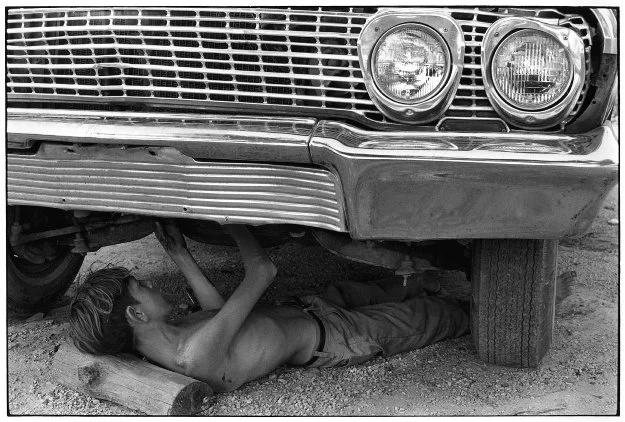
There used to be a guy.
Maybe he worked at the gas station.
Maybe he lived three houses down.
Maybe he was somebody's father, uncle or grandfather.
He wasn't an engineer. He didn't have a YouTube channel. He didn't call himself a maker.
He just knew how shit worked.
He could listen to an engine stumble and start narrowing down the problem before the hood was open.
He knew what a rich spark plug looked like.
He knew when a bearing sounded wrong.
He knew how to set points, rebuild a carburetor, patch an exhaust, free a seized fastener and make a bracket when the bracket he needed didn't exist.
If he didn't know, he took the thing apart.
That was not unusual.
That was America.
THE MECHANICAL MIDDLE CLASS
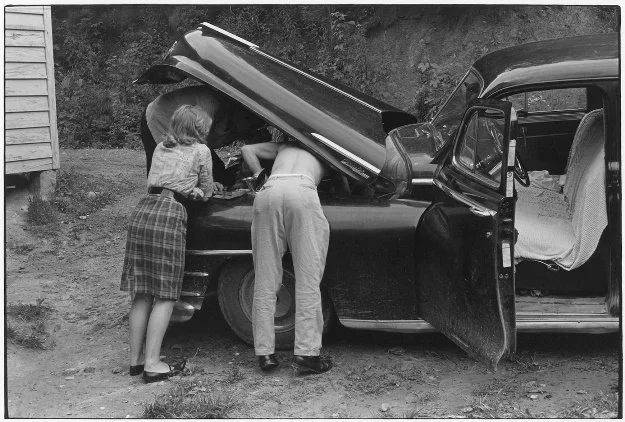
For most of the twentieth century, mechanical knowledge wasn't reserved for professional mechanics and wealthy collectors.
Machines were everywhere, and they required attention.
Cars needed tune-ups. Motorcycles needed adjustment. Lawn equipment needed repair. Factories needed machinists. Gas stations had service bays. High schools had vocational programs. Garages accumulated tools because eventually somebody needed them.
You learned because the machine made you learn.
And there was an economic ladder into the culture.
You couldn't afford the good car, so you bought the bad one.
The bad one didn't run.
Now you had a choice.
Learn or walk.
That produced something we're going to call the mechanical middle class: ordinary people with enough knowledge to understand, maintain and modify the machines around them.
Not master technicians.
Capable people.
The distinction matters.
SHOP CLASS
Nostalgia has a bad habit of turning the past into something it wasn't.
Not every American teenager in 1972 could rebuild a small-block Chevy.
But hands-on vocational education occupied considerably more space in American schools than it later would.

Federal education data show that 22 percent of high-school seniors were enrolled in vocational programs in 1972. By 1992, that figure was 12 percent.
The coursework changed too. Between 1982 and 1992, vocational credits fell as a share of the average public high-school graduate's coursework from 21 percent to 16 percent.
There were reasons: increased academic graduation requirements, changing labor markets and a growing emphasis on college.
Some of that represented progress.
But when you remove places where young people learn by touching things, fewer young people get the accidental education that comes from touching things.
You can't become comfortable with tools from a PowerPoint.
THE MACHINE CHANGED TOO
Then the machines got better.
Much better.
A modern car can start in freezing weather, idle perfectly, monitor itself constantly, make extraordinary power from a small engine, run cleaner and travel enormous distances with remarkably little routine intervention.
That is not decline.
That is engineering winning.
But reliability changed the bargain.
An older machine regularly asked its owner:
How much do you know?
A modern machine can go years without asking.
Then something fails.
And increasingly the answer isn't visible.
It's electronic.
Software-controlled.
Networked.
Protected behind proprietary diagnostics.
Integrated into an assembly that may make more economic sense to replace than repair.
In 2021, the Federal Trade Commission's report to Congress on repair restrictions identified manufacturers limiting spare parts, using designs that impede repair and making diagnostic software unavailable. The Commission said it found scant evidence supporting many manufacturer justifications for repair restrictions.
This isn't a complaint that computers ruined cars.
Computers made cars astonishing.
It's a different question:
What happens to mechanical literacy when the machine stops inviting you inside?
THE BLACK BOX
A carburetor can be intimidating.
It can also be understood.
Fuel goes somewhere.
Air goes somewhere.
A mechanical linkage moves.
Take one apart carefully enough and eventually its logic reveals itself.
The same is true of points, drum brakes, a manual gearbox, a motorcycle clutch or a simple electrical circuit.
Modern systems can be understood too.
But increasingly you need another layer of access before understanding can begin.
A scanner.
Software.
A subscription.
A proprietary tool.
A service portal.
Sometimes authorization.
The relationship changes.
The old machine says:
HERE'S HOW I WORK. FIGURE ME OUT.
The new machine increasingly says:
SOMETHING IS WRONG. ASK SOMEONE WITH PERMISSION TO FIND OUT WHAT.
That is not the same experience.
THE KIDS AREN'T THE PROBLEM
Here's where the easy version of this story falls apart.
Young people haven't stopped wanting to build things.
America is currently short of technicians.
TechForce Foundation's 2026 analysis of federal workforce data estimates 241,842 annual technician openings across ten skilled sectors against 101,743 technical-school and community-college graduates.
And technical-school completions increased 7.6 percent in the latest year.
Gen Z is showing up.
So maybe this isn't a story about a generation that forgot how to work.
Maybe we spent decades reducing the number of places where they could learn.
And maybe they're learning different machines.
A kid tuning an ECU is still tuning.
A kid designing a bracket in CAD and printing a prototype is still fabricating.
A kid learning from a teardown video is still learning from somebody who knows more than he does.
A laptop can be a tool.
So can a multimeter.
So can a hammer.
The point isn't to freeze mechanical culture in 1974.
The point is to preserve the instinct to open the thing.
AIR. FUEL. SPARK.
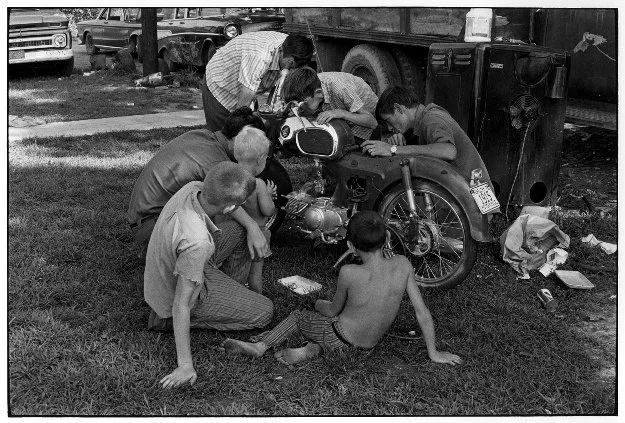
Imagine buying an old motorcycle that doesn't run.
You press the starter.
Nothing useful happens.
No screen explains the failure.
No error message tells you what to order.
The machine simply refuses.
Now somebody gives you three words:
Air.
Fuel.
Spark.
Suddenly the dead motorcycle becomes a problem that can be divided.
Is air getting in?
Is fuel getting there?
Is the plug firing?
Three questions become six.
Six become twelve.
You get one wrong.
You buy the wrong part.
You strip something.
You swear.
You learn what an extractor is.
Eventually the engine coughs.
Then it runs.
Something changes at that exact moment.
The motorcycle isn't just yours because your name is on the title.
It's yours because you understand a little piece of it.
THE RIGHT TO UNDERSTAND YOUR OWN SHIT
Right-to-repair arguments are usually framed around money and competition.
They should be.
If manufacturers unnecessarily restrict parts, manuals, diagnostic tools or software, consumers and independent shops can lose choices and repairs can become more expensive.
But there is another consequence that's harder to price.
Every barrier between a person and the thing they own is also a barrier between ownership and understanding.
We shouldn't need every product to be simple.
We shouldn't pretend safety, emissions, cybersecurity and sophisticated electronics don't matter.
We should ask something more basic:
When you buy a machine, how much of it are you still allowed to know?
THE LAST GUY
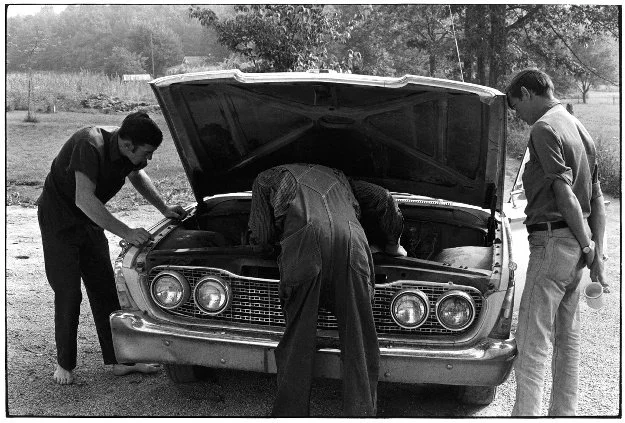
Someday the last guy who knows how to rebuild a particular carburetor will rebuild his last one.
That's fine.
Technology isn't supposed to stand still so we can feel nostalgic.
Nobody needs to preserve the experience of adjusting points on the side of the road simply because our grandfathers had to do it.
But somewhere between rebuilding everything and replacing everything, we should decide which skills are worth carrying with us.
Teach somebody how to use a wrench.
Show them why you support the back of a piece of metal before you hit it.
Show them what a spark plug can tell you.
Let them change a tire.
Let them fuck something up.
Make them fix it.
This is why SMUG TOOLS cares about tools.
Not because old tools photograph well.
Not because garages look cool on a shirt.
And not because we're interested in cosplaying somebody else's working life.
A tool is access.
It is permission to participate.
It is the thing between looking at a machine and touching it.
Machines don't need us the way they used to.
Maybe that's exactly why we still need them.
Sources:
NCES — Trends Among High School Seniors, 1972–1992
https://nces.ed.gov/pubs95/95380.pdf
NCES — Vocational Education in the United States
https://nces.ed.gov/pubs/web/95024-2.asp
FTC — Nixing the Fix: An FTC Report to Congress on Repair Restrictions (May 2021)
https://www.ftc.gov/reports/nixing-fix-ftc-report-congress-repair-restrictions
FTC — press release on Nixing the Fix
https://search.ftc.gov/news-events/news/press-releases/2021/05/ftc-report-congress-examines-anti-competitive-repair-restrictions-recommends-ways-expand-consumers
TechForce Foundation — 2026 Technician Supply & Demand Report
https://techforce.org/supplydemand/
Images from William Gedney photographs and papers, 1887, circa 1920, 1940-1998 and undated, bulk 1955-1989 from Duke University Archives