

GM’s Futurliner made a travelling stage out of a truck. After a weekend encounter, we look at the work behind the spectacle—and why it still gets us outside.
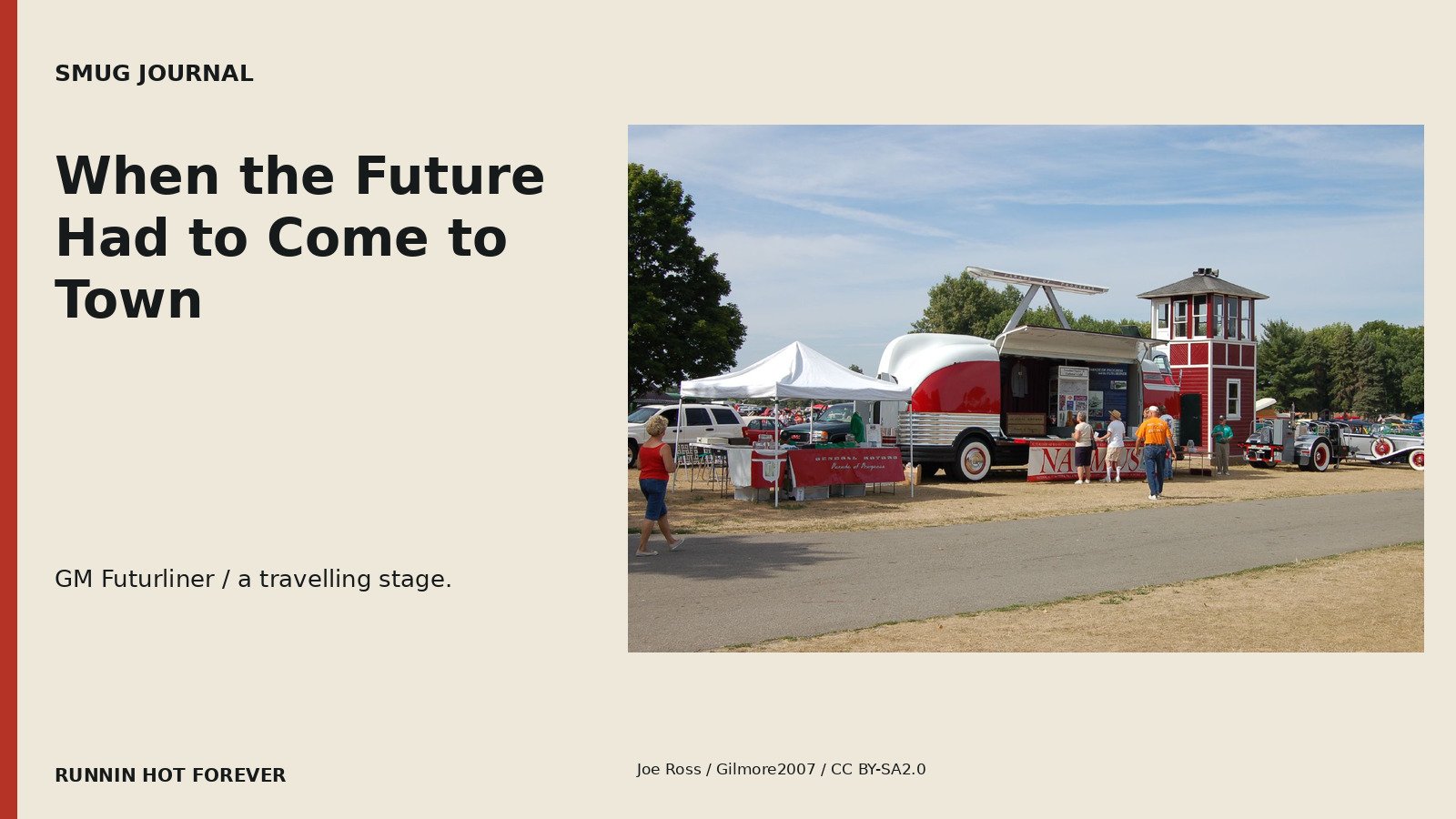
The GM Futurliner was one of the machines that stayed with us after the weekend. It has the useful effect of making the word “vehicle” feel insufficient. You can look at the body, the lettering and the elevated cockpit for a long time before getting around to the question of what anybody needed it to do.
The answer makes it better. General Motors built a travelling exhibition into a fleet of enormous vehicles. The Futurliner could arrive, open its side and become a place for people to stand in front of an idea. It carried the presentation equipment and supplied part of the theatre. [1][2]
There is something wonderfully demanding about that arrangement. Before the audience could see the future, somebody had to get it down the road.
First, find an audience
GM’s own history traces the Parade of Progress to research director Charles Kettering and the company’s experience at the 1933 Chicago World’s Fair. The first road caravan appeared in 1936, using Streamliners. The twelve Futurliners belonged to the next phase, which went on tour in 1941. [1]
That sequence matters. The Futurliner was part of an evolving method of exhibition, rather than an isolated styling exercise with nowhere to go. A spectacular body helped persuade people to come closer. Once they did, the show had a job waiting for them: watch a demonstration, follow an explanation, imagine a different way of living.
Think about the work implied by a travelling exhibition. There is a route to organise and a place to set up. Equipment has to survive the journey. A presentation needs to make sense to the next audience as well as the last one. The machine outside is only the visible edge of an operation.
A body that becomes a room
The federal Historic American Engineering Record describes the Futurliners as custom steel-bodied trucks made to hold promotional, scientific and educational displays. It dates construction to summer 1940. The body’s purpose was exhibition; the bus-like silhouette can give the wrong impression if you imagine rows of passenger seats. [2]
GM describes a vehicle about 33 feet long, with large side panels that opened into stages and display areas. The driver reached a high glass cockpit by stairs. Even without a demonstration running, those arrangements make the object unusually legible. The top belongs to the person moving it; the broad side belongs to the people coming to look. [1]
The proportions do much of the introduction. You can see the exhibition surface before you know the exhibit. The white roof and bright lower trim break up the bulk, while the lettering gives the eye somewhere to settle. It is the sort of design that rewards walking around rather than finding one approved camera angle.
In Joe Ross’s 2007 photographs of Futurliner No.10 at the Gilmore Car Museum, the open panel is the detail to study. People gather at the side at an ordinary human scale. The surrounding cars, tents and visitors make the size understandable in a way a clean studio photograph might not.
Those are historical reference photographs of a different survivor. They are not photographs of the freshly restored New York machine. Keeping that distinction visible makes both stories easier to appreciate.
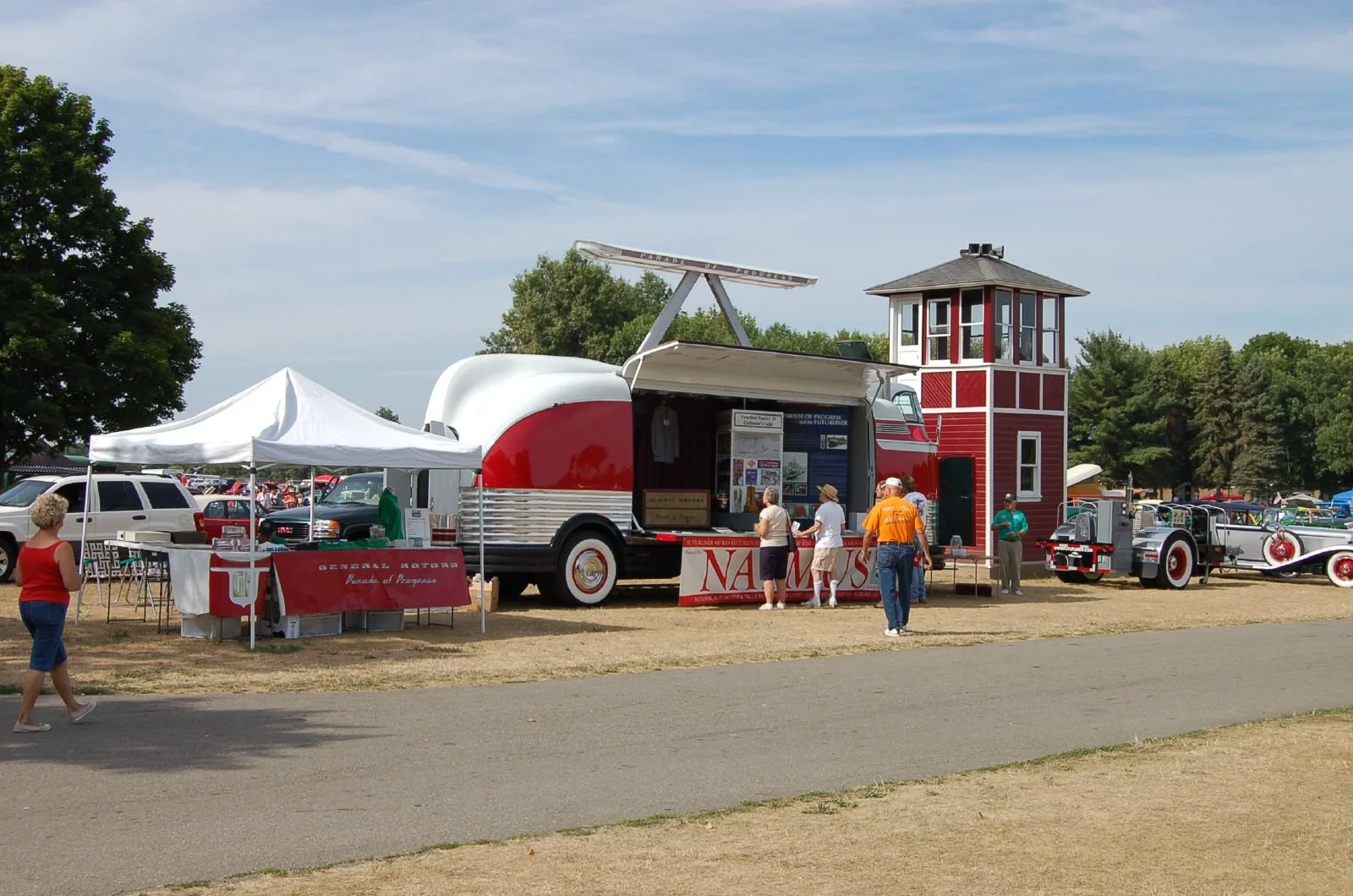
No10 with display panel open, Gilmore2007. Historical reference, not this weekend or current NY restoration. Photo by Joe Ross.
The show required people
A preserved 1953 GM account, hosted by the National Auto and Truck Museum’s restoration project, describes a crew of roughly sixty. Their duties included presenting the material, driving and putting up the tents. The programme offered demonstrations of subjects including refrigeration, aviation and electronics, with admission free. [3]
That list brings the spectacle back down to the ground. Someone had to know the explanation and someone had to know where the equipment went. The polished surface was supported by a day’s work, then another day’s work in another town.
It is easy to admire the visible extravagance and overlook the repetitive competence. But repetition was the point. An exhibition that could only be assembled once would have been a different proposition. This one needed to be packed, moved, rebuilt and understood again.
For anyone who has loaded a small pop-up, carried a display upstairs or realised that the one important cable is back at the shop, that is the most relatable part of the Futurliner. Its scale makes the logistical problem impressive. The underlying problem is familiar.
The future had a point of view
A company-funded science exhibition is also a presentation of how that company wants the world to see it. The Parade’s name makes its confidence fairly explicit. Progress is the attraction, and GM is helping bring it into view.
That does not make the demonstrations uninteresting. It gives us another thing to look at. What did the programme choose to show? How did it make an unfamiliar process understandable? What kind of audience did it imagine standing at the side of the truck?
The useful response is to keep looking at the machine and the message together. The body promises something important inside. The presentation needs to justify the promise. When you separate those two jobs, you miss why so much design and labour went into getting an audience in the first place.
There is a lesson there for a much smaller shop. Make the introduction worth noticing, then have something worth showing when somebody stops. You cannot finish that job with a logo alone.
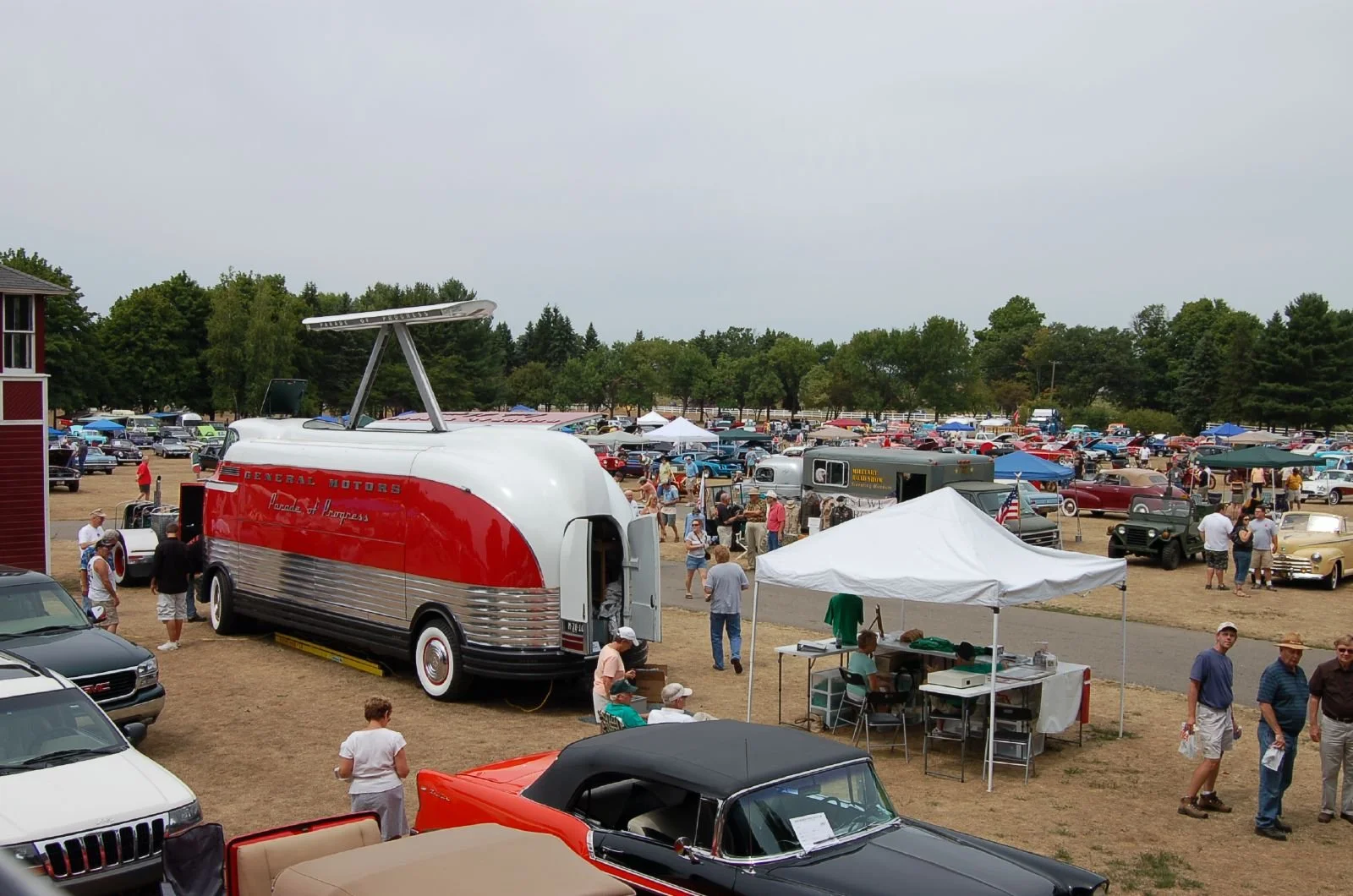
Second view of No10 at Gilmore2007, photographed from an elevated position. Historical reference, not this weekend or current NY restoration. Photo by Joe Ross.
Which version are you looking at?
The fleet changed over time. The museum project records the 1953 rebuilding, including the transition away from the earlier bubble canopy. Its account also describes the difficulties of the high cockpit and the original canopy’s heat. Different survivors can therefore show different phases of the design. [4]
This is why a restoration choice matters. Returning to an earlier appearance changes the face people meet, and the story they think they are looking at. A smoother or more familiar later detail can conceal how strange the original proposition felt.
For the New York restoration, duPont REGISTRY’s announcement describes Rob Ida’s team returning a surviving Futurliner to its early styling, including a recreated bubble canopy. The report calls the vehicle a 1939 Futurliner, while GM’s history and the federal record date the fleet to 1940. Here, we use 1940 for fleet construction and distinguish that from the earlier design being recreated. [5][1][2]
The announcement places the restored vehicle at Rétromobile New York, November 19–22. It is a contemporary opportunity to look at a historical design decision in three dimensions, rather than flattening every surviving example into one generic red-and-chrome bus. [5]
Back outside
Our weekend interest in the Futurliner started with seeing the machine. Research adds names, dates and a clearer account of its work. It also improves the next look. Now the side panel is a stage, the cockpit is a working position, and the whole body is part of a travelling presentation.
That is a good reason to go to a gathering in person. A photograph can start the question. Standing beside the object tells you which question to ask next. The best machines keep supplying them.
We are heading to Rétromobile on Friday, November 20, as part of a day that continues at the SMUG shop and Hill Country. The route is in Tuesday’s Journal. If you see the Futurliner there, give the side of it as much attention as the front.
It was built to give people somewhere to gather. That part of the idea still works.
Editorial source record
1 / General Motors
Company history; Parade chronology and basic vehicle/stage description.
https://news.gm.com/home.detail.html/Pages/topic/us/en/2025/apr/0402-1940-gm-futurliner.html
2 / HAER IN-114
Federal engineering record: summer1940 construction and exhibition-truck purpose; record concerns No10.
https://tile.loc.gov/storage-services/master/pnp/habshaer/in/in0500/in0546/data/in0546data.pdf
3 / 1953 GM account, NATM archive
Crew duties, free admission and demonstration subjects.
https://www.futurliner.org/1953para.htm
4 / National Auto and Truck Museum restoration project
1953 rebuilding/canopy changes; do not transfer late mechanical specifications to current New York vehicle.
https://futurliner.org/fh.htm
5 / duPont REGISTRY announcement
Current Ida restoration, early canopy styling and scheduled New York display.1939label acknowledged with primary-source1940discrepancy.
https://news.dupontregistry.com/blogs/news/restored-1939-gm-futurliner-debuts-at-retromobile-new-york
Photo source / Joe Ross
Gilmore Car Museum,2007; No10; CC BY-SA2.0.
https://commons.wikimedia.org/wiki/File:Futurliner_at_gilmore_2007_(1144562400).jpg

Photo source / Joe Ross
Second view from 2007 Gilmore event; CC BY-SA2.0.
https://commons.wikimedia.org/wiki/File:Futurliner_exhibit_from_bus_(1144488732).jpg
