

Ford Supervan turned a familiar working shape into a racing spectacle. Even its chassis history deserves a closer look.
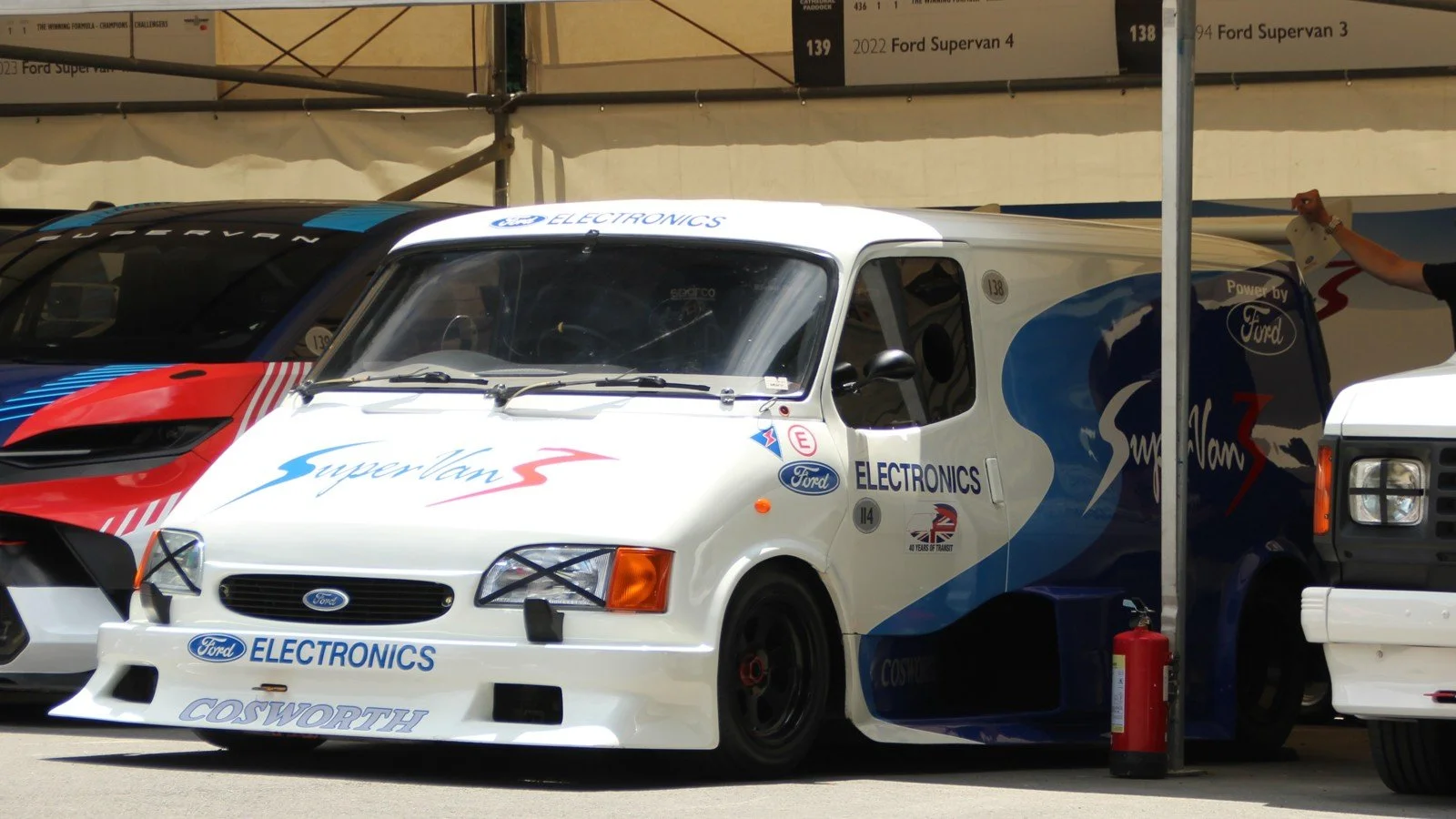
The later Ford Supervan 3, photographed in 2025. This is not the 1971 original discussed in the opening. Photo or illustration: Calreyn88 / CarspotterCal
A van has a very useful advantage as a performance joke: nobody expects the punchline. A racing car announces itself before it moves. A familiar commercial shape has to do something unreasonable before the audience adjusts its expectations.
Ford Supervan made that adjustment happen in public. Ford’s 2024 retrospective dates the original’s first public appearance to 1971. It identifies a GT40-derived V8 inside a Transit body, but the chassis was from a Cooper Monaco racing car. That last detail is worth holding onto. “A GT40 under a van” is a memorable shortcut; it is not the precise account supplied by the later restoration reporting. [V1, V2]
Ford’s interview with former engineering apprentice Andy Browne explains that the Terry Drury Racing mechanics widened the Cooper chassis to suit the body. It is a better story when the fabrication remains visible: different pieces brought together to make something that had no good reason to exist except that it would be magnificent to watch. [V2]
The campaign ended and the object kept going
According to Ford’s account, the original was stripped of valuable components after its promotional work. Browne bought what remained in 1973 and worked to return it to use. Years after selling it, he recognized surviving remains through details of changes he had made himself. The later rebuild used original components and the memories and material supplied by people connected to the van. [V1]
That is the part of machine history a specification table cannot preserve. Someone knows why a sill was changed. Someone remembers a particular exhaust. What looks like damage or an awkward modification can become the evidence that identifies the object. The insignificant detail becomes the important one.
The Supervan idea survived in other forms. Ford’s retrospective describes Supervan 2 in 1985 and a 1994 transformation into Supervan 3, with racing hardware becoming increasingly elaborate. The licensed photograph accompanying this piece shows Supervan 3, not the 1971 original. The body changes across the family, but the pleasure of the mismatch remains. [V2]
There is no practical argument for expecting every work van to become a racing car. That would spoil the joke and make deliveries expensive. Supervan works because a shape associated with useful, ordinary labor suddenly behaves like something from another part of the paddock.
Look at the van. Then look at what is holding it up. Those can be two very different stories.
Sources
V1 Ford Ford Marks Transit Day with Three Generations of Supervan 2024
V2 Ford Meet Supervans Super Fan 2024