

A seized Harley, a Canadian semi and an alleged maritime shipment reveal different relationships between outlaw motorcycle clubs and the business of smuggling.
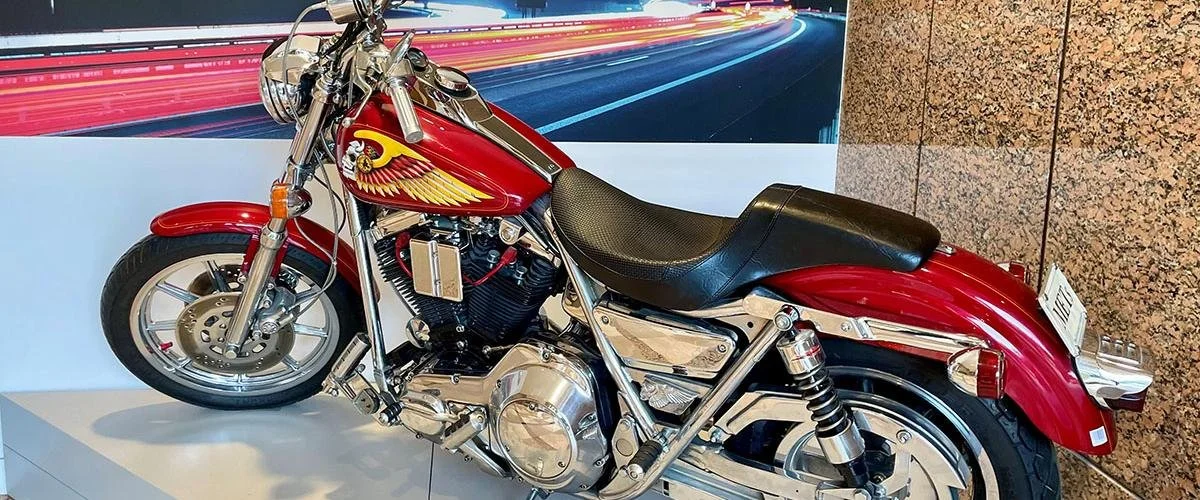
1993 Harley-Davidson was seized after an investigation led by a DEA Mobile Enforcement Team. Photo from the DEA Museum.
The red Harley-Davidson in the DEA Museum’s collection looks like the machine you expect to find in this story. Chrome, paint, a large front wheel and enough visual presence to make an ordinary car seem apologetic. It is a 1993 motorcycle seized from the president of the Salem, Massachusetts, Hells Angels chapter. [F1]
The reason it entered the collection is more specific than the picture suggests. According to the museum, it was purchased with illicit funds. Its documented significance is as an asset bought with criminal proceeds. That description does not establish that the motorcycle itself carried a shipment of drugs. [F1]
That small distinction opens a much bigger story. A motorcycle can organize a social world, announce membership, absorb money, become evidence or carry something. Those are different relationships to crime. Once they are collapsed into one dramatic image, the machinery becomes scenery and the history gets worse.
The motorcycle and the organization
There are documented connections between particular outlaw motorcycle organizations and trafficking. There are also millions of reasons to look at a motorcycle that have nothing to do with a criminal case. A machine’s appearance cannot settle what its owner did.
The useful unit is the case: which organization, which people, what conduct and what result. A 2010 federal jury convicted the Outlaws’ national president and three other members of racketeering-related offenses in Virginia. The prosecution described an organized hierarchy and violence against rivals; the announcement also reported an acquittal of a Pagans member charged in the case. Even within one investigation, the legal outcomes were not interchangeable. [F5]
A separate 2013 South Carolina prosecution documented Hells Angels members and associates convicted of offenses involving narcotics, firearms, robbery and money laundering. That record matters because it shows activity involving a network of people and transactions, rather than a photograph of a group ride standing in for evidence. It remains a record of those defendants and that investigation. [F6]
The club structure is part of what investigators examine. So are associates, money and the connections between places. The patch can explain an affiliation. It cannot, by itself, explain a shipment.
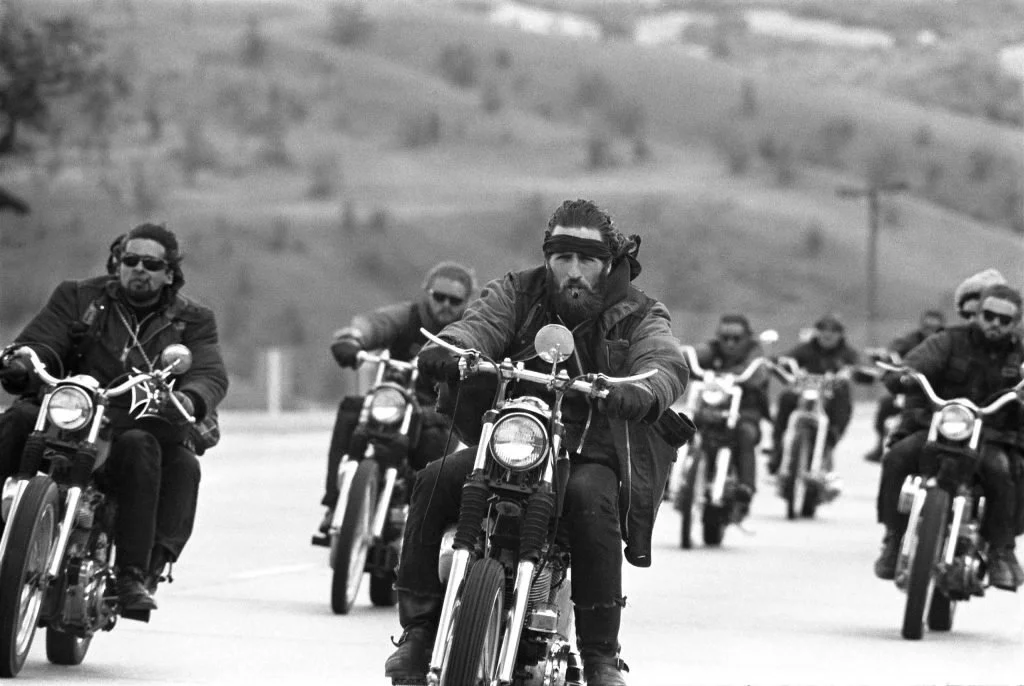
Hells Angels, California, 1965. Photo: Bill Ray; Life Pictures/Shutterstock
A Harley paid for with drug money
The Salem investigation gives the red motorcycle a concrete history. A DEA Mobile Enforcement Team joined local and state police in 1995. The museum describes an eighteen-month investigation into the chapter’s cocaine and methamphetamine distribution. Raids in September 1996 led to sixteen members and associates being arrested; the museum records subsequent imprisonment in 1997. [F1]
The motorcycle survives as an object from that investigation. The published artifact entry identifies its year and manufacturer, but does not identify a model or engine family. Calling it a particular FXR, Softail or engine type would add a level of certainty the entry does not supply.
Here the vehicle is a purchase and a possession. That is already a substantial connection to the business. Money made elsewhere has acquired a physical form: paint, metal and a machine somebody chose to own. There is no need to invent a secret compartment to make the object interesting.
The semi in the court record
For a vehicle directly connected to cross-border carriage, the record becomes less cinematic and much larger.
In May 2013, a federal court sentenced Canadian truck driver James Postlethwaite to twelve years in prison for conspiracy to distribute marijuana, following his November 2012 trial conviction. The US Attorney’s Office described him as a transporter for a criminal group related to the Hells Angels. Its account says the organization moved marijuana into the United States and cocaine into Canada. [F2]
Investigators identified his semi-truck through a Seattle-area warehouse. The sentencing release describes repeated transportation, multiple participants and distribution beyond the border region. It also records a prison sentence for a pilot who transported drugs for the ring. The account identifies the truck’s role, but not its manufacturer or model; it does not establish a particular aircraft type. [F2]
This is the point where a motorcycle-club story becomes a transport story. The vehicle doing a documented job was a semi. The people connected to the organization did not all need to be on motorcycles for the organization’s relationships to matter.
That makes the machine more interesting, not less. Looking only for a photogenic bike would miss a central piece of the case.
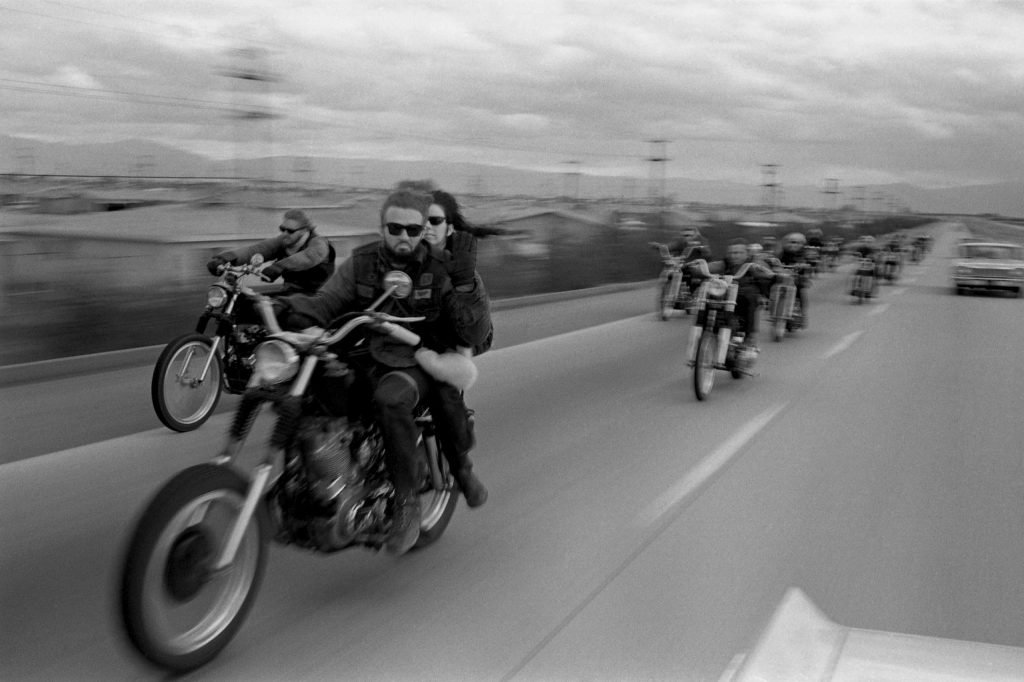
Hells Angels cruise north from San Bernardino to Bakersfield, 1965. Photo by Bill Ray; Life Pictures/Shutterstock
Private vehicles before the spectacular machines
A historical Vermont assessment from the National Drug Intelligence Center makes a related observation at the level of regional reporting. It describes occasional cross-border marijuana smuggling by Hells Angels members, primarily in private vehicles. This is an agency assessment of conditions at that time, not a conviction of every person it describes. It does not name a preferred model. [F3]
The same page discusses other types of transport, but proximity on a page is not proof of a shared organization. Its separate helicopter seizure should not quietly become a Hells Angels helicopter story simply because that would make a better headline.
That is a useful discipline for anyone interested in contraband machines. An object can have the right era, the right paint and the right apparent attitude while having no documented connection to the operation in question. An ordinary vehicle with a supported role is a better subject than an extraordinary one borrowed from somebody else’s case.
An allegation at sea
The vehicle range also extends beyond roads. In an April 20, 2026, joint announcement, Australian agencies described a catamaran intercepted near the Queensland–New South Wales border and a man charged over an alleged cocaine importation. They said the broader suspected syndicate had links to outlaw motorcycle gangs. [F4]
That wording needs to remain intact. The announcement reports charges and an alleged syndicate connection. It does not identify a particular club in that description, and it does not make a conviction out of an accusation. The vessel’s make and model are not supplied. This article recounts the announcement, not a verified final outcome in that prosecution. [F4]
For the machinery story, the important fact is the type of craft in the official account: a catamaran. It widens the frame beyond the obvious image of a motorcycle run. It does not license us to invent a fleet, assign ownership to a club or describe every boat in a harbor as part of the same world.

What the objects can actually tell us
Placed together, these records give several distinct answers to the question of what outlaw motorcycle clubs had to do with smuggling. The Salem Harley is tied to illicit proceeds. The Canadian semi is connected to a convicted transport conspiracy. The Vermont assessment describes private vehicles in historical reporting. The Australian catamaran belongs to an account of alleged activity and charges.
The relationships are the story. Buying a motorcycle, transporting contraband and being named in an allegation are not interchangeable events. Nor do these examples establish a universal history for every outlaw club, country or period. The strongest vehicle-specific records examined here are concentrated on Hells Angels-linked cases, with the Outlaws prosecution providing a separate example of documented organizational crime.
There is still plenty to look at. A machine selected as a possession tells us something about aspiration. A truck tied to a completed prosecution tells us something about the physical scale of an operation. A vessel in an agency announcement tells us where the evidence currently being described begins—and where it stops.
The next time a photograph promises an outlaw machine, ask for its biography. Who owned it? What was it used for? Is that use documented? Was it seized as proceeds, evidence or something else? If the answer is only a story about the paint, keep looking.
The motorcycle belongs in the frame. So does the truck. The case gets interesting when you can tell what each one was actually doing.
Research & Sources:
F1 DEA Museum Harley Davidson accession 2000 1 1https://museum.dea.gov/museum-collection/collection-spotlight/artifact/Harley-davidsonF2 DOJ Canadian trucker sentenced May 7 2013https://www.justice.gov/usao-wdwa/pr/canadian-trucker-sentenced-12-years-prison-drug-conspiracyF3 NDIC Vermont assessment May 2003https://www.justice.gov/archive/ndic/pubs3/3999/marijuan.htm
F4 ACIC joint announcement April 20 2026https://www.acic.gov.au/media-centre/media-releases-and-statements/nsw-man-charged-over-alleged-plot-import-200kg-cocaine-after-sea-transfer-queensland-coastF5 DOJ via FBI archive December 21 2010https://archives.fbi.gov/archives/washingtondc/press-releases/2010/wfo122110.htmF6 DOJ via FBI archive June 19 2013https://archives.fbi.gov/archives/columbia/press-releases/2013/hells-angels-members-and-associates-convicted-and-sentenced-after-joint-investigation-uncovers-racketeering-conspiracy-dealing-in-guns-drugs-armed-robbery-arson-and-money-laundering