

Safety wire is a tiny detail with a serious job. It also teaches you how to look at a machine.
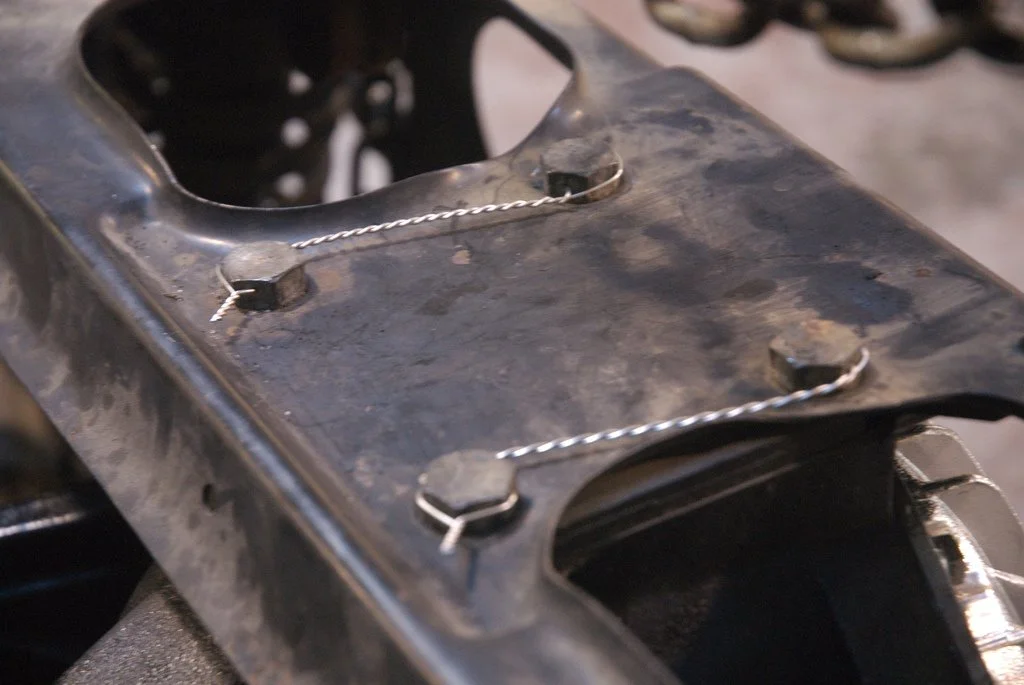
Safety wiring of two pairs of drilled bolt-heads wired one-to-the-other. Photo from Wikipedia
A twisted strand between fasteners is easy to overlook until you understand why someone put it there. Then it becomes one of the most interesting things in the engine bay. A person expected vibration, movement and consequences. They made a small physical provision for all three.
Safety wire is a locking method. Routed correctly, its tension opposes a fastener’s tendency to loosen. The FAA describes wiring components together so that movement toward loosening is resisted by the wire. The important quality is the direction of restraint, not how photogenic the twisting looks. [T1]
That distinction is useful for anyone whose first encounter comes through a beautifully prepared machine. The finish can be immaculate while the detail is wrong. The FAA’s own illustrated sheet includes an example with tidy-looking twists routed in a direction that pulls the filter loose. Appearance needs an explanation. [T1]
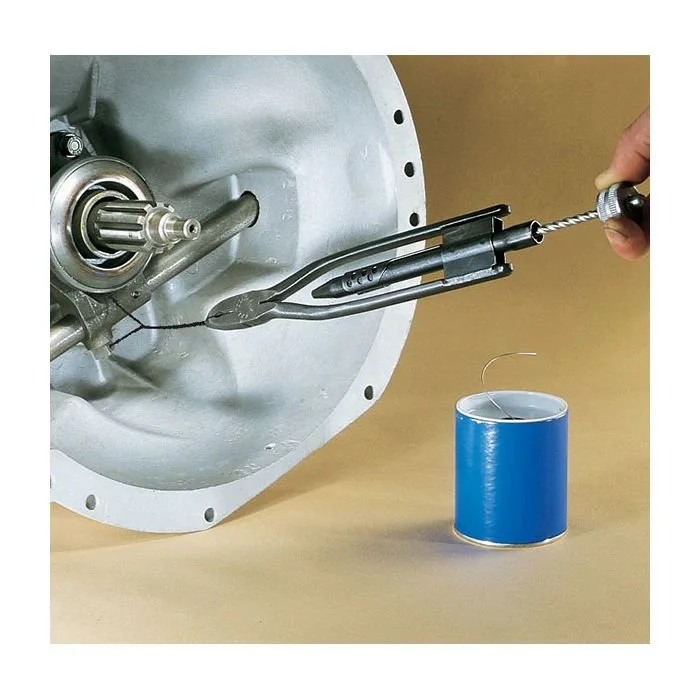
Safety Wire Pliers from Eastwood Auto
The tool leaves a signature
Safety-wire pliers belong to that world of jobs with a very specific finish. Their locking jaws and twisting mechanism help produce a controlled run of twisted wire. The completed work can look delicate, almost decorative, until you follow it from one fixing point to the next. [T3]
At a show, that is the satisfying part. Find a fastening point, trace the wire and look at what would happen if the fastener tried to move. You are reading an intention in metal. It invites a different conversation from asking whether a finish is original or how much an engine makes.
The FAA’s examples put the method on engine accessory fastenings and control hardware, where a small part coming loose can have a much larger effect. Follow the line from the fastening point toward the component it retains and the tiny detail acquires a different scale. [T1]
A restraint has a defined job
Wire does not rescue an incorrectly installed fastener. The FAA specifically distinguishes proper tightening from the additional locking step and identifies the wire as single-use material. Its guidance sits within a much wider body of maintenance instructions. [T1, T2]
The right arrangement depends on the component and the applicable instructions. An engine accessory, an aircraft control and a competition vehicle have different requirements. A photograph of good workmanship can teach observation; it cannot supply the specification for your own assembly. [T2]
This is why the most useful question is often “What is that doing?” rather than “Where can I buy that look?” One gets you a story about a function. The other can leave you with an expensive imitation of a decision someone else understood.
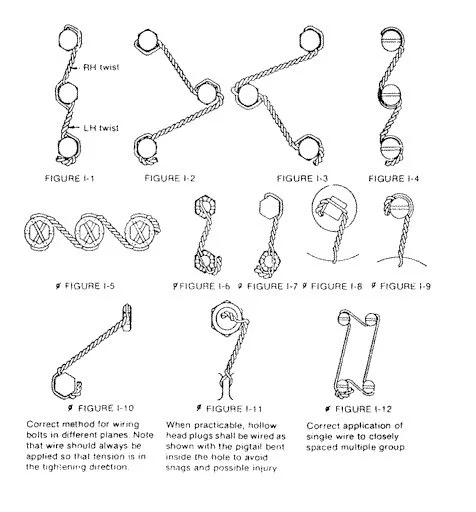
Safety Wire or Lock Wire installation diagram from Malin Co.
Look past the polished cover
Next time a bonnet is open, spend a minute on the things holding everything together. Notice access, retention and the places where a mechanic expected to return. Ask the owner which details came from actual use and which arrived during a rebuild. There may be a much better story in a small fastening point than in the longest specification sheet on the windshield.
A well-prepared machine rewards that kind of attention. Once you begin following the small things, the big thing becomes easier to appreciate. The wire is hardly the star of the photograph. It may be one reason the subject stayed in one piece long enough to be photographed.
Research & Sources:T1 FAA Safety Wire fact sheet
https://www.faa.gov/sites/faa.gov/files/2022-01/Safety%20Wire.pdf
T3 Snap on wire twister product announcement
https://public.snapon.com/a_prodannouncements_us/RWTP6_RWTP9_npa.pdf
T2 FAA AC 43 13 1B
https://www.faa.gov/documentlibrary/media/advisory_circular/ac_43.13-1b_w-chg1.pdf