

How a rain-soaked Le Mans upset found its way onto a Turbo Blue Audi.
A Porsche 935 K3. Three drivers. A race that nearly turned into a Hollywood ending. And a street-car tribute that refuses to pretend it was ever on the grid.

The number doesn’t make our Audi a Le Mans winner. It makes the question worth asking.
LE MANS, 1979. NOT EXACTLY A CALM WEEKEND.
By Sunday morning, the 1979 24 Hours of Le Mans had turned into the kind of story that sounds better every time someone retells it. The rain was miserable, the factory prototypes had stumbled, and a white No. 41 Porsche 935 K3 from Kremer Racing was trying to hold on to an overall lead it was not supposed to surrender.
Then came the sort of problem that makes a twenty-four-hour race worth watching: Don Whittington had to stop for an emergency repair out on the circuit. Behind the Kremer car was another Porsche, No. 70, with Dick Barbour, Rolf Stommelen—and Paul Newman—in its lineup. The crowd could practically see the movie ending. But No. 41 made it back and finished the job.
Klaus Ludwig and brothers Don and Bill Whittington won Le Mans in the Kremer 935 K3. Porsche describes it as the first overall victory by a Porsche customer team. A private operation, a dreadful-weather race, and a number you could pick out through the spray: 41.
SO WHY IS 41 ON AN AUDI?
Because the number is a way into the story, not a claim to its result.
SMUG 41 is our Turbo Blue Audi A5 Sportback project: a road car, not a vintage Porsche in disguise, and not a race car dressed up as an excuse to talk about horsepower. The plan is to carry the spirit of the privateer era into a car that actually gets driven. A modern shape with old racing references. A little irreverence, but a reason behind every mark.
The important part of the 1979 story isn’t just that an underdog won. It’s that a specialist racing outfit could build its own answer, stand next to the giants and make everyone else talk about it afterward. That do-it-yourself confidence is much closer to the SMUG world than a perfectly polished showroom tribute.
THE BLUE PAINT GETS A VOTE.
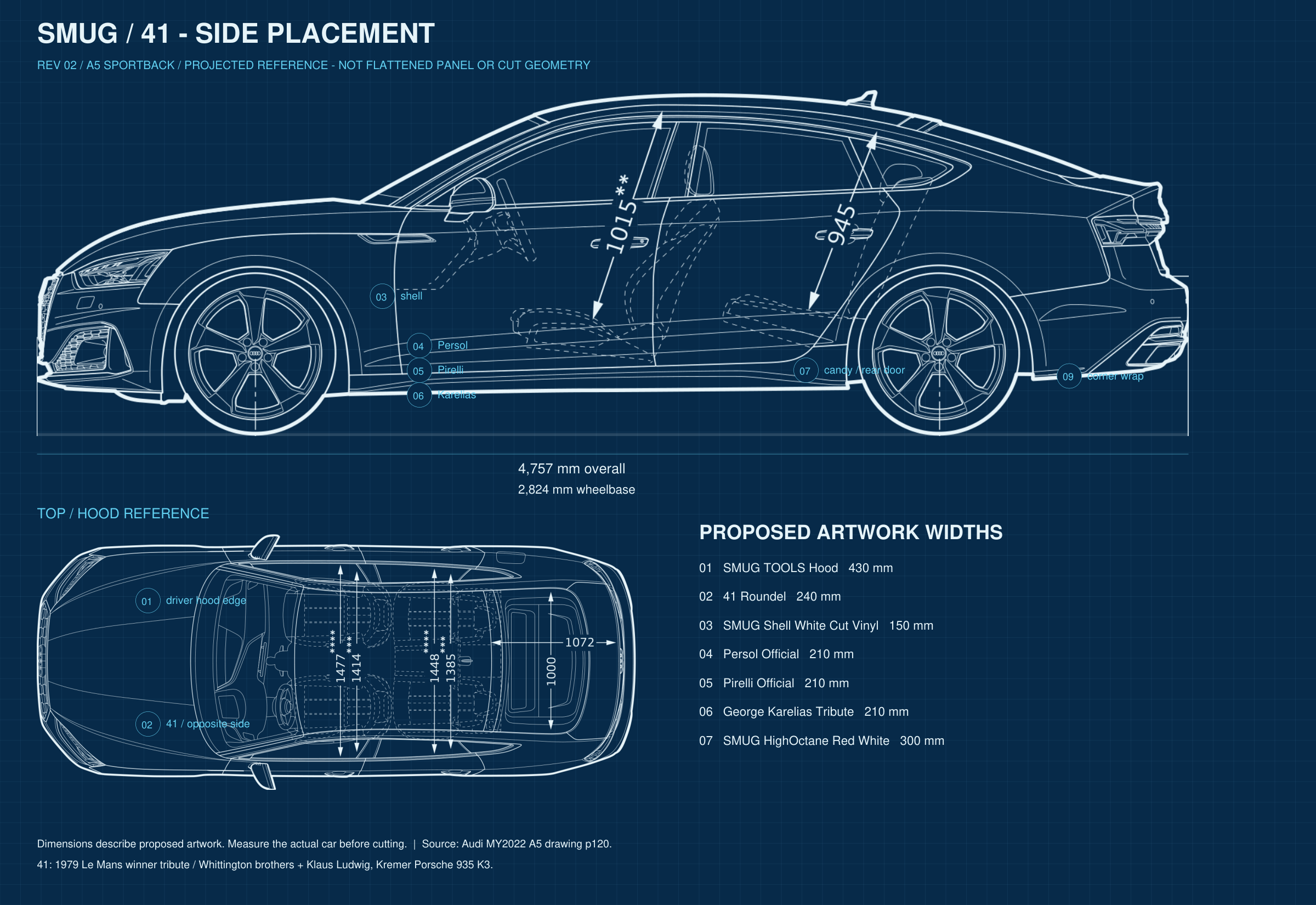
The layout starts with the car we have, not the car in the archive. An A5 Sportback has four doors, different body breaks and a completely different attitude from a 935 K3. Trying to copy the Kremer livery panel-for-panel would miss the point.
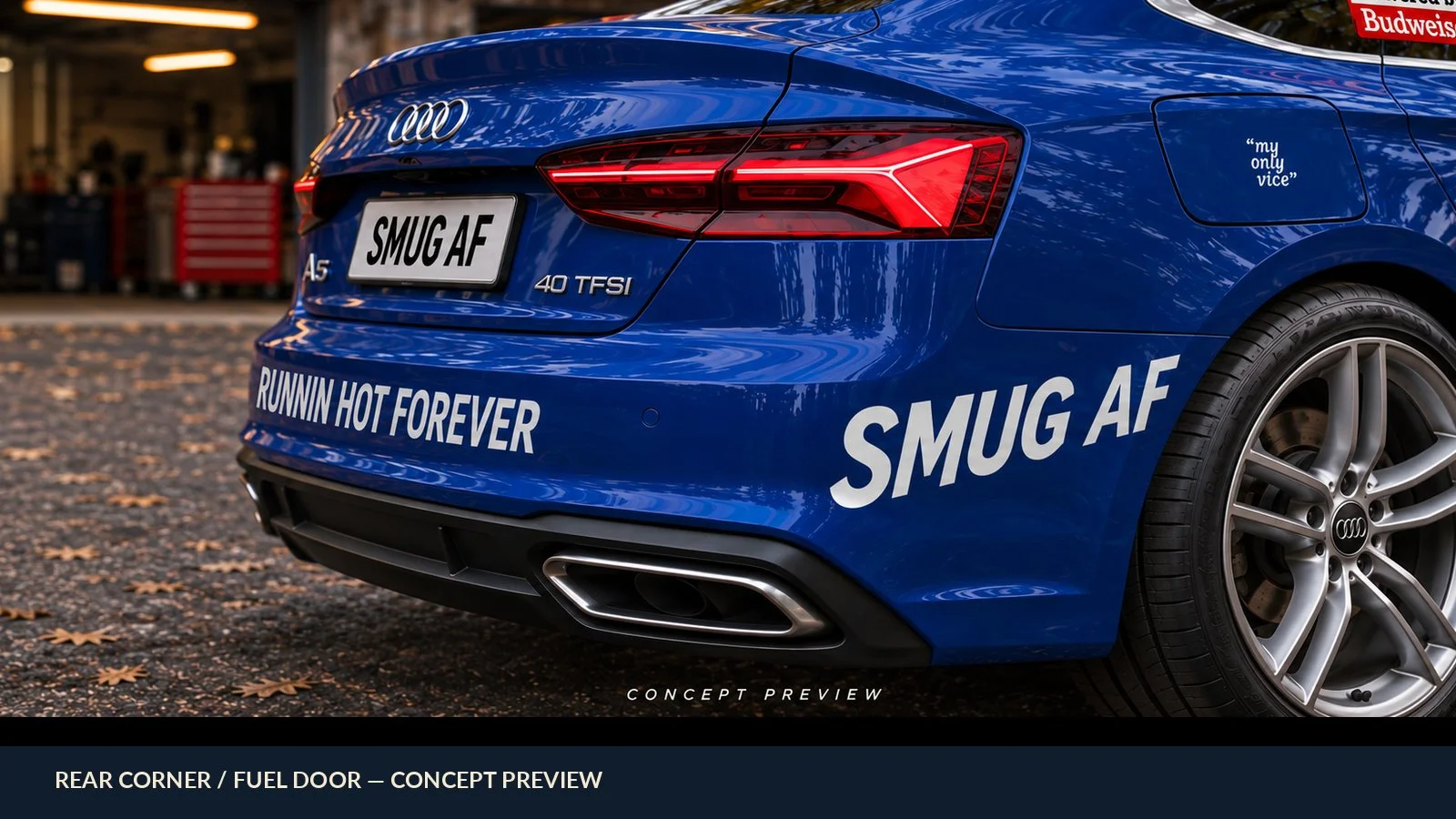
So the No. 41 roundel becomes the anchor. White graphics work against the Turbo Blue paint. The SMUG TOOLS lettering gives the build its identity; smaller racing-flavored marks reward a closer look. Around the rear bumper corner, the proposed SMUG AF graphic turns the corner rather than stopping politely at the edge. Near the fuel door, “my only vice” sits small enough to make somebody come closer.
Not every inch needs a sticker. A good race livery knows when to be loud. A good street car also knows when to shut up and let the bodywork do something. We’re trying to find the sweet spot between the two.
A TRIBUTE YOU CAN DRIVE.
There is no attempt here to borrow somebody else’s trophy. The Kremer crew earned theirs in France in 1979. SMUG 41 is a contemporary nod to that era—when the cars looked dangerous, the paddock was full of characters, and the improbable stories were often the best ones.
The images accompanying this story are concept renders and placement drawings. They show the direction under development, not a claim that every decal has been installed. That distinction matters. So does leaving room for the car—and the idea—to evolve.
If the number gets somebody asking about the Whittingtons, Klaus Ludwig, Kremer, or the miserable weather at Le Mans, it has already done its job. If it starts another conversation about a garage, a wild road trip or the sort of driver who never took the obvious route, even better.
That’s what we want from a tribute. Not nostalgia under glass. A good story back out on the road.
RUNNIN HOT FOREVER.
SOURCE RECORD / EDITORIAL FACT CHECK
Automobile Club de l’Ouest — The art of driving in the rain (1979)
https://www.24h-lemans.com/en/news/24-hours-of-le-mans-the-art-of-driving-in-the-rain-4-porsche-935-1979-19979
ACO — Victorious Porsche 935 / 1979
https://www.24h-lemans.com/en/news/the-victorious-porsche-at-the-24-hours-of-le-mans-3-the-935-12557
Porsche Museum — Le Mans Overall Winners / 1979
https://www.porsche.com/international/aboutporsche/porschemuseum/successstorylemans/champions/overall/